Key Takeaways
To broadcast online, you need three things: a physical setup (computer, microphone, headphones), broadcasting software to encode your audio, and an online radio hosting platform to deliver your stream to listeners.
An online radio hosting platform like RadioCult is what connects your equipment to your audience: without it, your stream has nowhere to go.
Broadcasting software options include free tools like BUTT and Mixxx, and paid options like VirtualDJ and Audio Hijack.
USB microphones like Audio Technica ATR2100x and Blue Yeti are recommended for beginners; XLR microphones like Shure SM7B offer professional quality.
A basic setup can cost under $100 if you already own a computer; a professional setup may cost $300 to $600.
Getting an internet radio station on air involves more than just a microphone, but the full setup is less complicated than most people expect. There are three components you actually need: the physical equipment on your desk, broadcasting software that encodes and sends your audio, and an online radio hosting platform that receives that stream and delivers it to listeners across the internet.
This guide covers all three. Whether you're building a community station, launching a DJ stream, or just want to know what you're getting into before committing to anything, you can realistically be broadcasting within a day of reading this.
Sign up for a free 7-day trial
Get 7 days freeComputer
The most essential item for a prospective internet radio station is a computer. In fact, a half decent modern computer with a solid internet connection is the only purchase you’ll need to make if you’re really strapped for cash.
Whether you should buy a PC or Mac really comes down to personal preferences as either operating system has a very limited effect on the other equipment and software needed. The computer you ultimately purchase should have an audio input, audio output and USB ports. But there’s no need to stress if your device is lacking the aforementioned ports due to the prevalence of cheap adapters.
Broadcasting software
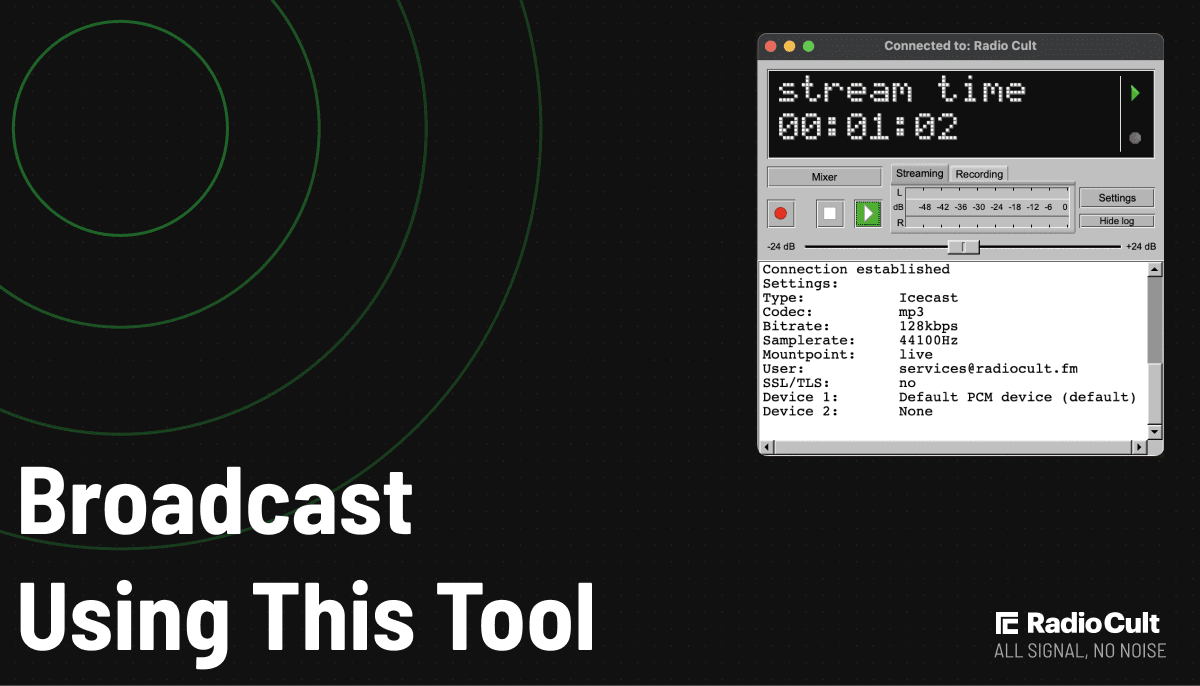
The next item on our broadcasting equipment list is broadcasting software. These computer programs simply put, encodes audio from your computer and transmits it out to your internet radio platform of choice.
There’s a range of different products to choose from. The more basic tools are generally free and usually only stream audio from your computer with no other functionality. The more advanced products likely require some form of payment, but they do offer more features such as media management or mixing capabilities.
The following list is a selection of the most popular broadcasting software available:
- BUTT (Windows, Mac and Linux): is a free, easy to use, multi-OS broadcasting tool,
- Mixxx (Windows, Mac and Linux): is a free and open source DJ software tool with livestreaming capabilities,
- VirtualDJ (Windows and Mac): is a very popular DJ software, but requires a paid subscription for most uses, and
- Audio Hijack (Mac): is a professional-grade recording tool which includes live broadcasting functionality.
For a deeper look at each option, read our internet radio software guide. For help connecting your software to RadioCult, see our help section.
Online radio hosting platform
Broadcasting software encodes your audio and sends it somewhere, and that somewhere is an online radio hosting platform. The platform receives your stream and delivers it to listeners on the internet. Without one, your equipment and software have no way to reach an audience.
The hosting platform is also where you manage the rest of your station: scheduling automated content for when you're not live, uploading pre-recorded shows, managing presenters, and tracking listener analytics. It's the operational hub for your station, not just a delivery pipe.
RadioCult is built specifically for independent and community internet radio stations. It connects directly with broadcasting tools like BUTT, Audio Hijack, and MIXXX, handles 24/7 automation between your live shows, and gives you a clear interface for managing your schedule, media library, and team. Plans start at $33/month with a 7-day free trial.
Other hosted options include Live365, RadioKing, and Airtime Pro, each with different pricing structures and feature sets.
Microphones
We now move onto the next item of our list: microphones. The purpose of this type of broadcasting equipment should be self-explanatory. But it's important to note that a microphone is only necessary if you intend to live broadcast someone’s voice. If you intend to only play audio content such as playlists or pre recorded sets, you can probably do without one.
Having clear audio is essential for your station’s audience when listening to one of your presenters. So you do want a reasonable quality microphone. For stations new to the world of online radio, we recommend either the Audio Technica ATR2100x or the Blue Yeti. Both are USB microphones and each is excellent for beginners due to their affordability and ease of use. If you have more experience in broadcasting and are after a more professional setup, we would recommend XLR microphones such as the Shure SM7B paired with an audio interface.
Please refer to these Amazon links for purchasing the aforementioned microphones:
Headphones
The next item on our internet radio equipment list is headphones. Similar to microphones, a detailed explanation as to why your online radio station needs headphones is not warranted. Headphones are so commonplace these days, you already know what they do and you’ll likely have access to a pair already.
Not all headphones are equal however and you’re current set might not be best suited for online broadcasting. Ideally you want a pair which is closed back, is comfortable to wear for extended periods and are compatible with your other broadcasting equipment. We recommend the popular options of the Audio-Technica ATH-M50x and the Sony MDR-7506 due to their sound quality and their overall comfort.
Please refer to these Amazon links for purchasing the headphones we mentioned above:
Audio mixers
The final item on our list is audio mixers. Also referred to as mixing desks or broadcasting desks, this type of equipment enhances the quality and control of your online radio station’s audio. An audio mixer as the name implies, receives audio from various sources, which it then mixes and ultimately outputs to multiple channels in a consistent way. Say your internet radio station has a computer, microphone and turntables, adding an audio mixer to this setup would allow your broadcast to switch smoothly between these different audio sources.
If you’re only just starting out in internet radio, we would recommend the Behringer Xenyx 802S due to its price and its USB connectivity. For a more advanced option, our recommendation would be the Behringer DX2000USB Pro, which offers a greater number of features and inputs.
Please refer to these Amazon links for getting your hands on the mixers we just mentioned:
How to choose the right equipment for your budget
You can get further than you might expect by bootstrapping hardware you already own. A computer you have, free broadcasting software, and a RadioCult trial is a fully functional internet radio station. If you’re after a more dedicated setup, this guide has covered everything you need to get there.
Start a 7-day free trial and see how easy it is to get your station on air.
Get 7 days freeFrequently Asked Questions
How much does it cost to set up an internet radio station?
A basic setup can cost under $100 if you already have a computer. A USB microphone like the Audio Technica ATR2100x runs around $50 to $80, and free broadcasting software like BUTT handles the streaming. For a more professional setup with an XLR microphone, audio mixer, and quality headphones, budget $300 to $600.
Do I need an audio mixer to start a radio station?
Not necessarily. If you're only broadcasting from a single audio source (like a USB microphone or pre-recorded mixes), you can skip the mixer entirely. An audio mixer becomes useful when you need to blend multiple sources, such as a microphone, turntable, and computer audio, into one broadcast.
What's the difference between a USB and XLR microphone for radio?
USB microphones plug directly into your computer and are ready to use immediately, which is ideal for beginners. XLR microphones require an audio interface or mixer but offer better sound quality and more control over your audio chain. Most stations start with USB and upgrade to XLR as they grow.
Can I use my existing headphones for radio broadcasting?
You can, but closed-back headphones are recommended for broadcasting since they prevent audio from leaking into your microphone. Consumer earbuds or open-back headphones may cause feedback issues during live shows.