Key Takeaways
Find a niche you can genuinely own, then broadcast on a consistent, published schedule so listeners always know when to tune in.
Be discoverable everywhere your audience already listens: directories, mobile apps, smart speakers and archive platforms like Mixcloud and SoundCloud.
Turn every show into shareable proof, from short social clips to full archived mixes, to reach people who will never catch you live.
Grow reach through collaboration: cross-promotion with other stations and guest spots that borrow an established following.
Convert casual listeners into a loyal community with chat, a mobile home and email, and use analytics to double down on what actually works.
Do you run your own radio station, convinced you broadcast some of the best tunes around, yet the size of your audience does not reflect it?
You are not in uncharted territory. Growing a station's listenership is not a trivial task, and playing great music, while essential, is rarely enough on its own to reliably pull new people in. The good news is that the audience is out there. In the US alone, 76% of Americans aged 12 and over, around 219 million people, listened to online audio in the last week (Edison Research, The Infinite Dial 2026). Your job is to help a slice of them find you and stay.
In this guide we will walk through the tactics that work best for growing your radio audience, from carving out a niche to being discoverable everywhere, so you finish with a clear answer to how to get more listeners.
Let's dive in.
Carve out a niche you can own
For smaller or newer stations it is a trap to replicate content that is already broadcast well elsewhere. Wherever you are in the world, there are large, established stations playing the genres you might have been considering yourself, and competing head-on with them is a mammoth task. Instead, find a niche that is not already catered for.
If you love hip hop, we are not saying avoid hip hop. We are saying do something different with it, whether that is under-represented sub-genres, live mixing, or spotlighting local artists the mainstream ignores.
Your niche should also be something you are genuinely passionate about, because that enthusiasm comes through on air. Listeners are not only looking for audio they cannot get anywhere else, they want it from people who clearly love it too. For more on shaping this into a recognisable identity, see our guide to building a loyal listener base.
Broadcast on a consistent schedule
Discovery gets you a first listen. Consistency is what turns that into a habit. A station that goes live at unpredictable times, or drops long silences between shows, gives even keen listeners no reason to come back at a set point in their week.
Publish your schedule, stick to it, and make each slot something people can plan around. RadioCult's scheduling tools let you build a drag-and-drop calendar with real recurring rules, so a show that airs, say, every third Thursday keeps its slot automatically. Pre-records and playlists can fill the gaps so your station is always on, even when no presenter is at the desk.
Give your audience room to grow. RadioCult places no cap on concurrent listeners on any plan, so a viral moment never hits a ceiling. Try it free for 7 days.
Get 7 days freeMake your station discoverable everywhere
A website is a good starting point, but to really grow your audience your broadcast needs to be reachable on as many platforms as your listeners already use. Online listening is no longer a niche behaviour: according to the latest RAJAR figures, online now accounts for 30% of all UK radio hours, up from just 2% back in 2007 (Ofcom, Audio listening in the UK 2026).
Internet radio directories
Internet radio directories are single locations where listeners can browse and tune into countless stations. Many have large, ready-made audiences of people who are actively looking for something new to listen to, which makes them a great place to be found. The more popular directories also have their own apps, so a single submission can put you in front of mobile listeners too. Our directory submission guide lists the ones worth prioritising.
Mobile apps and smart speakers
The device mix has shifted. In the UK, smart speakers alone accounted for 18% of all radio listening in Q1 2025 (Ofcom, Media Nations 2025), and phones remain the everyday home for on-the-go listening. Giving people an easy app-based way to tune in matters.
RadioCult includes a free mobile app on every plan, available on iOS and Android, with live audio, your schedule, chat and even Shazam-style track ID for mixes built in. It is one less barrier between a curious listener and a regular one.
Archive platforms
Not everyone can catch you live, and on-demand listening is now mainstream. Podcasts alone reached 45% of Americans aged 12 and over in the last week (Edison Research, The Infinite Dial 2026), which tells you how many people prefer to listen on their own schedule.
Archiving past broadcasts to Mixcloud and SoundCloud meets those listeners where they are. Both user bases skew heavily towards people who are passionate about independent music, so uploads there tend to reach a far more receptive audience than a comparable following elsewhere. RadioCult makes this simple: record any event you broadcast at the click of a button, then archive it straight to Mixcloud or to SoundCloud from your dashboard.
Build a social presence and share clips
A presence on social media is essential. Facebook, Instagram, X and TikTok collectively reach billions of people, and any prospective listener almost certainly has at least one account, so meet them where they already are.
Use social to explain what your station is about, post your weekly schedule, introduce new residents and hosts, and promote upcoming events. Radio is audio-only, but social is multimedia, so lean into that: short video clips of a standout mix moment, a guest reaction or a behind-the-decks shot let people put faces to hosts and get a feel for you before they ever press play. A single 30 second clip that travels can do more for discovery than a week of text posts. For a fuller plan, see our guide to online radio station promotion.
Use SEO for your station's website
Search engine optimisation is about helping search engines understand your content so your site ranks as high as possible for relevant searches. Most people never look beyond the first page of results, so the higher you rank, the more likely a prospective listener lands on your site and tunes in.
For a detailed walkthrough, read our post on SEO for internet radio.
Grow through collaboration
Two of the most reliable ways to reach new people both involve borrowing someone else's audience.
Cross-promotion is where your station promotes another station's shows and they reciprocate. Some pairings are natural, such as two stations sharing the same resident, so fans follow that presenter across both. Others are more deliberate, like co-hosting a gig or a takeover weekend.
Guest spots work similarly. Inviting a guest who already has a following gives you a shot at converting part of that following into listeners of your own. Rotating in fresh guests regularly, whatever their audience size, steadily widens the circle of people with a personal reason to tune in.
See exactly where your audience is growing. RadioCult's real-time analytics show live listeners by country, city and device, with 12 months of exportable history. Try it free for 7 days.
Get 7 days freeTurn listeners into a loyal community
Audio is a deeply habitual medium. In the UK, 93% of adults listen to some form of audio each week, rising to 98% of 16 to 34-year-olds (Ofcom, Audio listening in the UK 2026). The stations that grow are the ones that turn that habit into belonging.
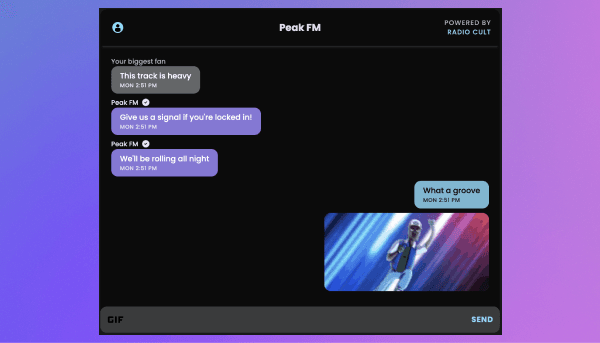
Give listeners a way to talk to you and to each other while a show is playing. RadioCult's chat rooms run live across web and mobile with reactions, moderation and no participant caps, so a good show becomes a shared moment rather than a solo one. Collecting emails, even a simple newsletter with the week's schedule and standout shows, gives you a direct line that no algorithm can throttle. And hosting the occasional physical event, solo or in collaboration, puts you in front of people who already love live music but have not found you yet.
Learn what works, then do more of it
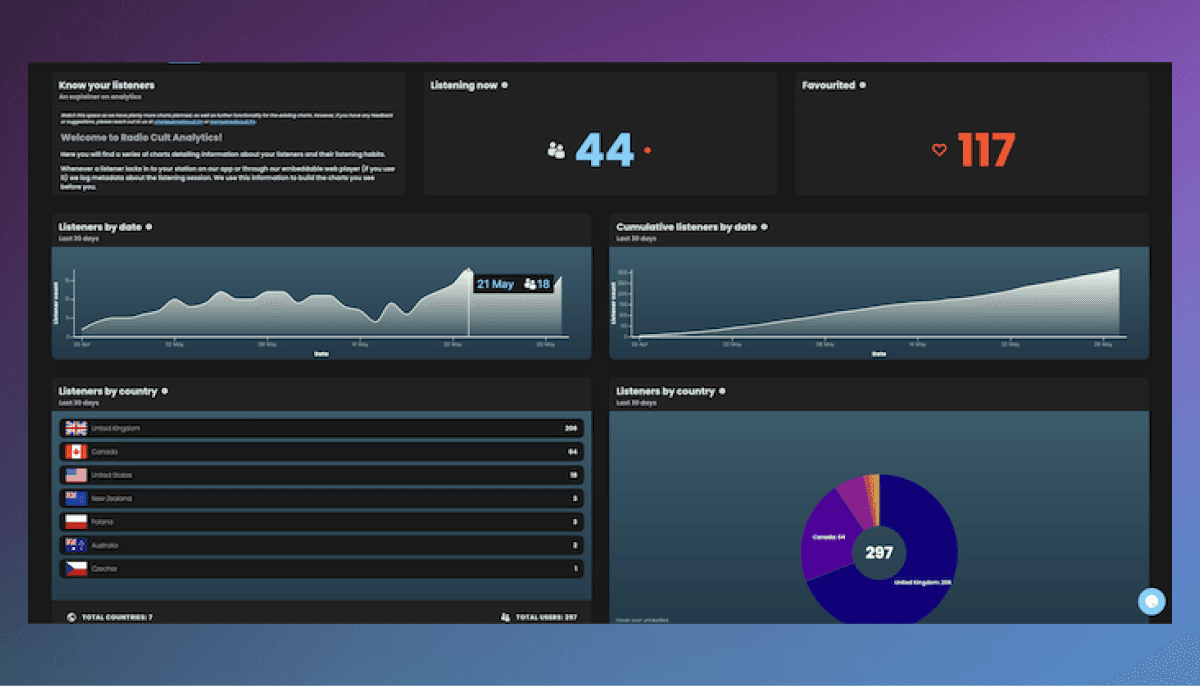
Growth is not guesswork. RadioCult's real-time analytics show your live audience, where they are listening from by country and city, what devices they use, and 12 months of history you can export. Watch which shows, guests and clips actually move the numbers, then put your time into those. The same exportable data doubles as proof of your audience value when you approach sponsors, partners or grant funders.
To wrap up
We have covered a lot of ground: finding a niche, broadcasting consistently, being discoverable across directories, apps and archives, sharing clips, using SEO, collaborating, building community and learning from your analytics. No single tactic is a silver bullet, but some combination of them is almost certainly your station's answer to getting more listeners.
Some of these require real investment. Many require little or no money, only your time. So if you want your audience size to match your belief that you play the best music around, start putting them into practice now.
Ready to grow your audience? Start your free 7-day trial with RadioCult and get unlimited listeners, a free mobile app, live chat and exportable analytics in one place.
As always, keep it locked.
FAQs
How do you attract radio listeners?
There are many ways, and this guide covers the most effective: owning a clear niche, broadcasting on a consistent schedule, getting listed in internet radio directories, sharing short clips on social media, collaborating with other stations, inviting guests, and building a community around your shows.
How can I promote my radio station?
Common methods include:
- Building a social media presence and sharing short-form clips,
- Using SEO for your station's website,
- Archiving shows to Mixcloud and SoundCloud, and
- Submitting your station to internet radio directories.
Our guide to online radio station promotion goes deeper.
How do you get people to listen to your radio station?
There are many ways, but the foundation is a well-defined niche broadcast on a schedule people can rely on. There is little point replicating what a larger, more established station already does. Whatever niche you carve out, it should at the very least be something you are genuinely passionate about, then make it easy to find and easy to come back to.