Key Takeaways
Yes, most stations want an owned home online, but "website" spans everything from a single link-in-bio to a full CMS site. Match it to your stage.
An owned presence protects you from platform changes in a way that social profiles and directories never can.
Embeddable players and schedule widgets let a simple site or link page punch well above its weight with very little effort.
A full website earns its keep once you care about discoverability, sponsors and credibility. Start small and scale into it.
There is a short answer and a longer one. The short answer is yes, most internet radio stations should have some kind of owned home online. The longer answer is that "website" covers a huge range, from a single link-in-bio page to a fully built site with its own domain, and the right amount depends entirely on where your station is today.
So the real question is not "website or no website?" It is "how much website do I actually need right now?" Let's work through it.
Owned presence versus rented platforms
It is tempting to run your whole station off Instagram, a Linktree and a directory listing or two. It is free, it is fast, and the audience is already there. The catch is that none of it is yours. You are building on rented land.
Platforms change their rules, tweak their algorithms and bury reach whenever it suits them. A directory can delist you. A social account can be locked overnight. When that happens, everything you built on top of it goes with it, and you have no direct line to your listeners.
An owned presence, even a small one, is the antidote. It is the one place you control completely, where you decide how listeners tune in and how you stay in touch with them. This is not a fringe view. Even outside radio, a Top Design Firms survey found that just over a quarter of small businesses (28%) still have no website of their own (Top Design Firms, via PR Newswire), which usually means leaning on social profiles instead. The ones that make that leap tend to do it for the same reason a station should: to stop renting their audience and start owning the relationship.
If you are setting things up from scratch, our guide to launching an online radio station walks through how the station, the site and the listener touchpoints fit together.
How listeners actually tune in now
Before deciding how much website to build, it helps to know where people are listening. Audio is not a small habit. In the UK alone, 55 million adults, some 95% of the population aged 15 and over, listen to audio in an average week, spending around 29.3 hours each on their favourite audio types (RAJAR MIDAS, Autumn 2025).
The way they reach that audio has fragmented, and that matters for you. Smart speakers now account for 18% of all radio listening, rising to 26% of listening at home, and online live radio makes up just over half (55%) of the time people spend listening on those speakers (Ofcom, Media Nations 2025). The number of people using online music services each week is now on a par with music radio, at around six in ten adults.
The takeaway is not that you need to be on every device. It is that listeners arrive from a lot of different places, and you want one reliable, owned destination you can point all of them towards. That destination does not have to be big. It just has to work.
A live-now player, schedule and recently-played widget can drop onto almost any page thanks to RadioCult's embeddable components. Try it free for 7 days and give listeners one dependable place to tune in.
The minimum viable presence
If you are early, you do not need a full site. A minimum viable presence can be as simple as a link-in-bio page or a single landing page that does three jobs: let people press play, show what is on, and tell them who you are.
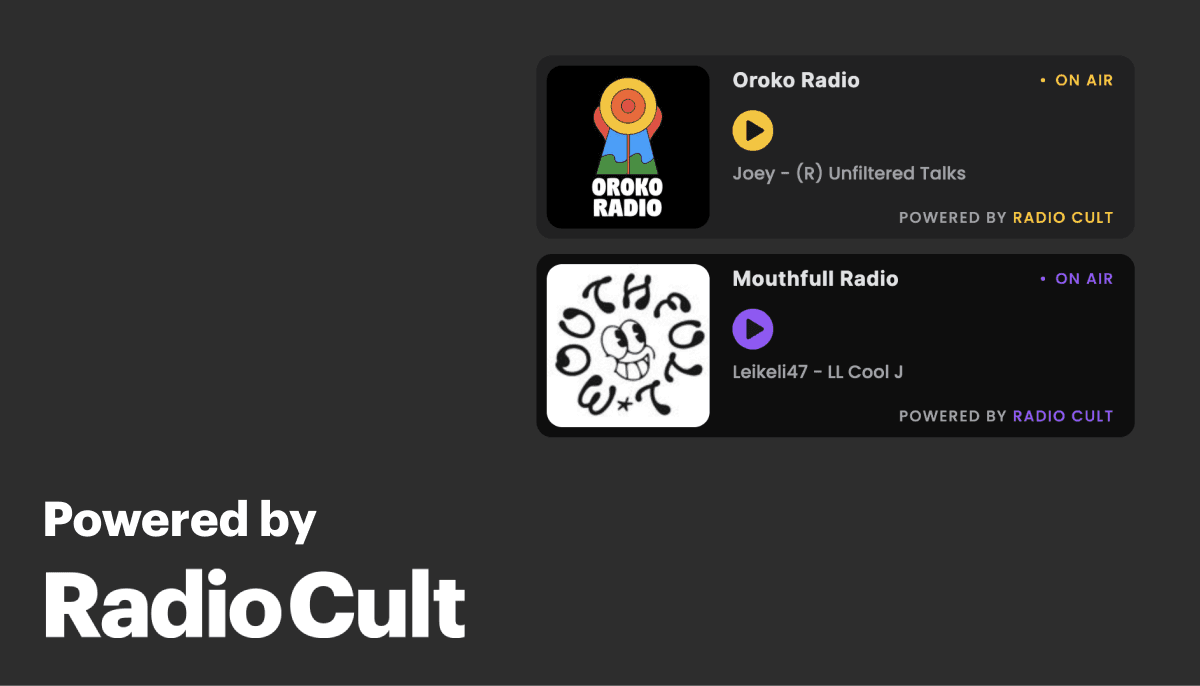
The trick that makes a small presence feel professional is embedding. Rather than building a player and a schedule from scratch, you drop in pre-built, embeddable components: a web player, a live-now widget, a full schedule and a recently-played feed. You can even point listeners at a hosted pop-out player with no site at all. Style it to match your brand or leave the defaults in place, and most listeners will never know it was not custom built.
If you want to add a player to a page you already have, our walkthrough on how to embed a player on your radio station's website covers the snippets and the common pitfalls. This is how a simple site or link page ends up doing the work of a much bigger one.
The mobile app as a companion presence
More and more listeners live on their phones, and some never touch a computer at all. That makes a mobile presence a genuine lever for growing your audience, not a nice-to-have.
The usual objection is effort: building your own app is a project in itself, which rather defeats the point of keeping things simple. That is why the RadioCult mobile app comes free on every plan. Your station gets a listed iOS and Android app with live audio, your schedule, chat and Shazam-style track ID for mixes, and you get it without writing a line of code. It works as a companion to a small website, or as the mobile front door while your web presence is still just a link page.
When you need a full website
A full website starts to earn its keep the moment you care about three things.
The first is discoverability. Social posts and directory entries are hard to find later and mostly invisible to search engines. Your own site, with real pages and content, is how people find you when they search for the kind of station you run. If that is a priority, our guide to SEO for internet radio is the place to start.
The second is credibility, especially with sponsors and funders. A station with its own domain, an on-brand player and a clear schedule simply looks like a serious operation. It also gives you somewhere to prove your reach: RadioCult's real-time analytics give you exportable listener data by country, city and device, the kind of evidence a sponsor or grant application actually wants to see.
The third is simply having a home. A full site becomes the place where your player, your schedule, your show archive and your story all live together, under one roof you control. When you reach that point, our how to create your online radio station website guide covers the wider build.
When you are ready for a full site, RadioCult's radio CMS and free mobile app let a simple presence punch well above its weight. Try it free for 7 days.
Cost and effort
The good news is that the jump between these stages is smaller than it used to be. A link-in-bio page costs nothing but a few minutes. Embeddable components mean you are not paying a developer to build a player. A full site can start on an affordable page builder and grow from there.
The honest cost is upkeep, not launch. A site you never touch drifts out of date and works against you. So build for the stage you are at. A single working page you keep current beats a sprawling site you cannot maintain, every time.
The bottom line
Does your internet radio station need a website? Almost certainly yes, in the sense that you want an owned home you control rather than renting your audience from platforms. But "website" is a spectrum, and you do not have to start at the deep end.
Begin with the minimum that lets people tune in, show what is on and find you again. That might be a link-in-bio and an embedded player today. Add the mobile app because it is free and it meets listeners where they already are. Then grow into a full site when discoverability, sponsors and credibility start to matter. Starting small is not a compromise. It is the sensible way in.
Ready to give your station a home listeners can actually find? Start your free 7-day trial with RadioCult and embed a player, schedule and mobile app in minutes.
As always, keep it locked.