Key Takeaways
AI tools can handle much of the administrative and repetitive work involved in running a station - transcription, content creation, graphic design, and more - freeing up time for the creative work that requires a human.
AI agents can now operate your station directly rather than just write about it, scheduling shows and tidying your library in plain language.
Transcription tools can turn recorded shows into show notes, social media content, and searchable archives with minimal additional effort.
LLMs like ChatGPT, Claude, and Gemini are well suited for drafting show descriptions, listener emails, social captions, and run of show outlines.
AI voice tools can generate convincing synthetic voices for station IDs and automation slots, but are not a substitute for a presenter your listeners are tuned in to hear.
None of these tools replicate what makes a station worth listening to - personality, community, and editorial voice still require humans.
AI tools can now handle much of the administrative and repetitive work involved in running an online radio station - such as scheduling, transcription, content creation, social media, graphic design and voice generation - freeing up time for the parts that actually require a human. They work best as a complement to the creative work, not a replacement for it.
AI has gone from buzzword to background noise. Three years ago, ChatGPT was a novelty. Today it's a utility - and the tools built on top of it have matured significantly. Several of them are now genuinely useful.
This isn't about AI replacing what your station is. It's about spending less time on the work that doesn't need a human, so you can spend more time on the work that does.
Letting an AI agent do the admin
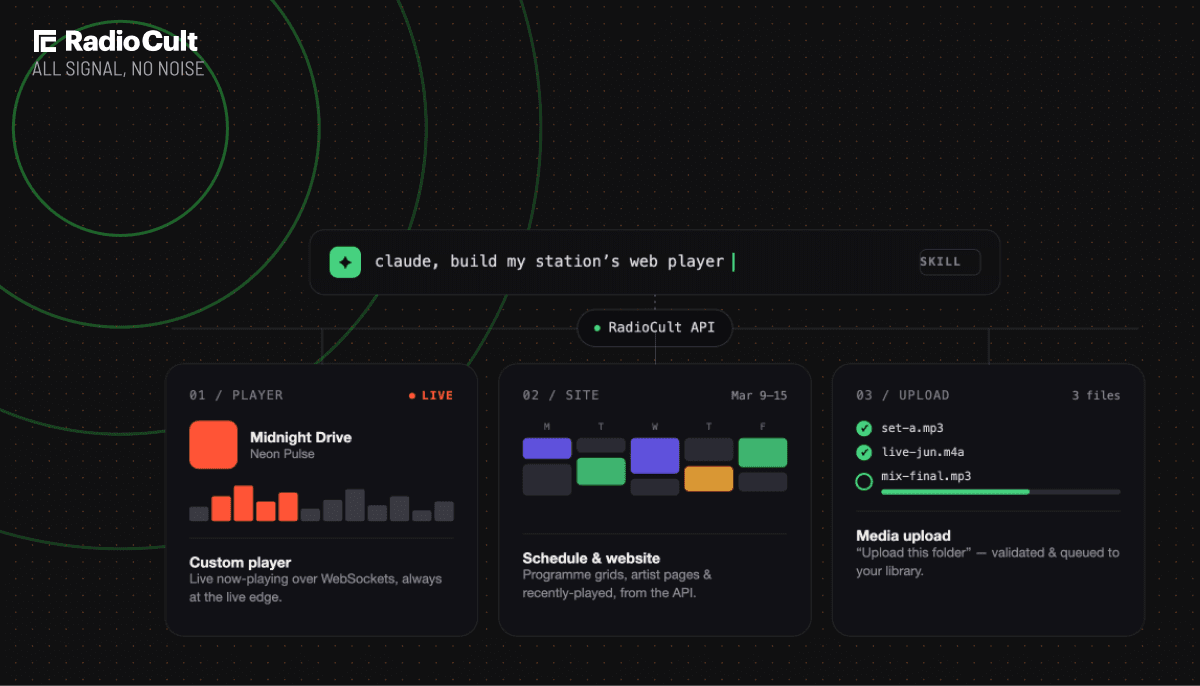
The biggest change since this article was first published is that AI tools stopped only producing text and images, and started operating software directly. An agent like Claude or ChatGPT can now connect to another system and carry out real tasks in it, through an open standard called the Model Context Protocol.
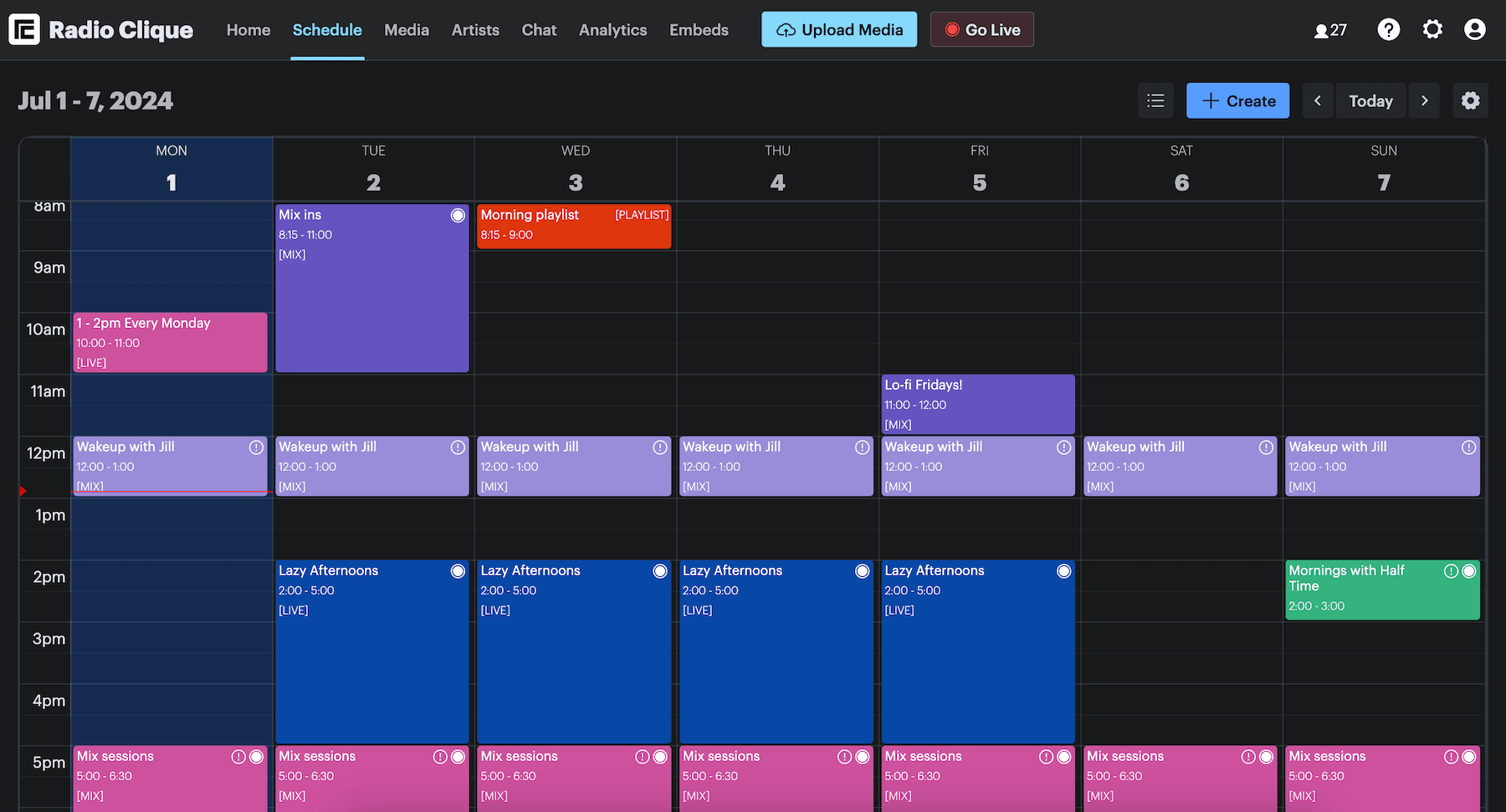
For a radio station, the work this removes is the work nobody enjoys. Rebuilding next week of shows. Tagging a night of new uploads. Tidying a playlist that has grown too long. Fixing a run of artist names that were entered inconsistently. None of it needs judgement, all of it needs somebody's evening.
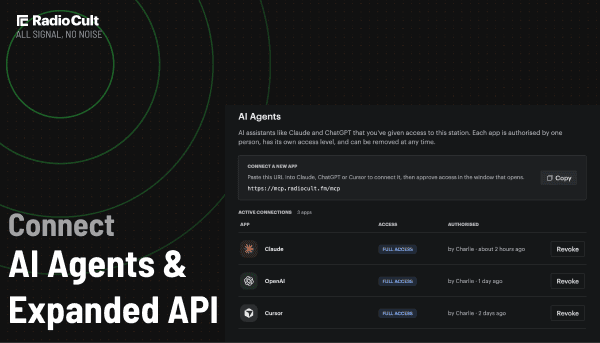
RadioCult supports this through Connect, which lets you point an AI assistant at your station and ask for what you want in plain language. It can create, update and delete shows, set up a repeating series, book artists onto events, and work across your tracks, playlists, tags and recordings. If you would rather write the automation yourself, the same actions are available over the RadioCult API, which suits the jobs that come round every week. There is a fuller walkthrough in automating your radio station with Connect.
Two things are worth knowing before you connect anything. You choose whether an agent gets read-only or read and write access at the moment you connect it, and you can revoke that access at any time. Start read-only if you want to watch how an agent works before letting it change anything.
Transcription and show notes
Tools like Otter , Descript, and OpenAI's Whisper can transcribe a recorded show with high accuracy in a fraction of the time it takes to listen to it. Once you have a transcript, the possibilities multiply:
Feed it into ChatGPT or Claude and ask for a show summary or episode description in seconds
- Pull out quotes and moments for social media
- Create SEO-friendly show pages on your website without writing them from scratch
- Build an archive of your station's content that's actually searchable
- For stations that record their shows, this workflow turns every broadcast into a week's worth of content with minimal additional effort.
Content creation
You don't want AI writing everything, but you do want it handling the parts that slow you down.
ChatGPT, Claude, and Gemini all have generous free tiers and are capable enough that their output requires minimal editing to sound like a human wrote it. Use them to outline, condense, and draft - not to replace your voice.
Specific use cases that work well for radio stations:
- Writing show descriptions from a brief prompt or tracklist
- Drafting emails to your listener community
- Turning a rough show concept into a structured outline or run of show
- Writing social media captions for upcoming broadcasts
The key is staying in the driver's seat. Give these tools your raw material and a clear brief, and they'll get you to a working draft faster than starting from scratch.
Social media and marketing
A step beyond content creation: tools like Castmagic and Descript are specifically designed to take audio or video recordings and extract promotional content from them automatically.
The output can include social media posts, quote cards, highlight clips, and newsletter copy - all derived from a show you've already recorded. For stations that struggle to maintain a consistent social media presence alongside everything else involved in running a station, this removes one of the main friction points.
Graphic design
Show artwork, social graphics, and event flyers are time-consuming to produce from scratch. Canva has integrated AI tools that make producing consistent, on-brand visuals faster than ever - even without design experience. For more custom work, tools like DALL-E (built into ChatGPT) can generate imagery from a text prompt.
Neither replaces a graphic designer for brand identity work. But for the week-to-week production of show artwork and social content, the barrier has dropped significantly.
Playlist generation
Tools like Playlistable let you generate playlists based on a reference track, artist, or mood. They work well for volume and similarity matching, less well for niche genres and emerging artists.
Where they genuinely help: finding music similar to a reference track, building playlists around familiar artists, surfacing highly anticipated new releases. Where humans still win: anything that requires genuine genre knowledge, taste, or awareness of what's happening in a specific scene right now.
Use them as a starting point and a time saver, not a replacement for curation.
AI mixing
Auto-mixing tools have improved significantly and are worth considering for stations that run scheduled playlist segments between live shows. DJ.Studio is the most established option - it analyses your tracks and generates mixes with intelligent transitions, giving automation slots a more polished feel without additional effort.
That said, the use case has a clear ceiling. The results can feel mechanical - technically competent but lacking the instinct and creativity that a human brings to sequencing music. For hosted shows in particular, the appeal is often the host themselves - their selections, their voice, their taste - and that's not something an algorithm is well placed to replicate.
Voice generation
Tools like ElevenLabs can generate realistic synthetic voices from a text prompt, and the quality has reached a point where the results are genuinely convincing. For stations that run pre-recorded links, station IDs, or show introductions, this opens up some practical possibilities - producing voice content without a presenter available, maintaining a consistent on-air voice across automation slots, or quickly generating filler content around scheduled programming.
That said, it sits in similar territory to AI mixing. A synthetic voice can fill a gap, but it doesn't replace the personality and presence of a real presenter - and for stations where its hosts are the draw, it's unlikely to be the right fit.
A note on what AI can't do
None of these tools replicate what makes a internet radio station worth listening to - the personality, the community, the editorial voice, the sense that real people are making decisions about what goes on air. That's the part that requires humans, and it's the part your listeners are there for.
The tools above are most useful when they're handling the administrative and repetitive work that sits around that creative core. That is true of the agents as much as the rest: an agent can build the week you decided on, but deciding what the week should be is still your job. Used that way, they free up time rather than replace what matters.